Buyer or Seller: Who Pays for What in a Real Estate Transaction?

You have found your dream home. The offer is accepted. Then you get the closing cost breakdown, your heart sinks, and you ask, “Where are all these fees coming from?” Even on the seller's side of the table, the feeling is similar; you knew there would be commission, but seeing just how much of your sales earnings will be eaten up by various taxes and administrative fees can still sting.
This confusion is completely normal, and first-time buyers and sellers go through it every single day. It is natural to feel overwhelmed when you see line after line of charges, especially if no one has explained them clearly ahead of time. You see, both buyers and sellers pay closing costs, and the total can be significant on both sides. However, the exact split depends on where you're buying, local customs, and the details of your purchase agreement. Knowing how to negotiate will allow you to save money.
Table of Contents
- Buyer or Seller: Who Pays for What in a Real Estate Transaction?
- Who Pays Closing Costs: Buyer or Seller?
- What Costs Does the Buyer Typically Pay?
- What Costs Does the Seller Typically Pay?
- Which Costs Are Negotiable Between Buyer and Seller?
- How Costs Vary by State and Local Practices
- How Title Costs Are Split Between Buyer and Seller
- How to Estimate Your Total Costs Before Closing
- Tips to Reduce Costs for Buyers and Sellers
- Frequently Asked Questions
Who Pays Closing Costs: Buyer or Seller?

The short answer is that both the buyer and the seller pay closing costs. However, they are responsible for different types of expenses:
|
Buyer Typically Pays
|
Seller Typically Pays
|
|---|---|
|
Loan origination and lender fees
|
Real estate agent commissions
|
|
Appraisal and home inspection fees
|
Agreed repairs or credits
|
|
Title search
|
Outstanding liens or debts against the property
|
|
Lender's and owner's title insurance
|
Owner's title insurance (largely dependent on state and local customs)
|
|
Prepaid expenses (taxes, insurance, escrow, interest, etc.)
|
Real estate transfer taxes
|
|
Recording fees
|
Unpaid HOA dues or special assessments
|
Keep in mind that this split is a general guide, not a fixed rule. Who pays what can vary based on state laws and local customs, and many of these costs can be shifted between parties through negotiation, especially in slower markets.
What Costs Does the Buyer Typically Pay?

Buyers are usually responsible for the majority of the closing costs, particularly fees tied to financing and due diligence. Here are the main expenses you should expect to pay for when buying a property:
- Loan Origination and Underwriting Fees: These are the service fees your mortgage lender charges for processing and approving your loan. They typically range from 0.5% to 1.0% of the loan amount. For example, on a $250,000 loan, expect to pay between $1,250 and $2,500.
- Appraisal: Lenders typically require appraisals before approving loans to confirm that the home's market value supports the loan amount. Most appraisals usually cost between $400 and $800, depending on the size and complexity of the property.
- Title Search: This fee covers the professional review of the property's ownership history to ensure it has a “clear” title. This typically costs around $200 to $400.
- Lender's Title Insurance: This is another common, and almost always mandatory, fee for buyers. The lender's policy protects the mortgage lender's financial interests in the property and typically costs 0.1% to 1% of the loan amount. For example, on a $350,000 loan, the lender's policy will cost you between $350 and $3,500.
- Home Inspection: This covers the cost of a physical examination of the property to identify potential structural issues and damages. Even though home inspections are not always required by lenders, they are strongly recommended and generally cost around $300 to $600, paid directly to the inspector.
- Prepaid Costs and Escrow: These are upfront payments for homeowners insurance, property taxes, and mortgage interest. They are not fees in the traditional sense and vary widely by location but can still add several thousand dollars to your total closing costs.
- Recording Fees: This covers the cost of registering the new deed and mortgage with the local county or municipal recording office. On average, expect to pay around $50 to $150 per document.
What Costs Does the Seller Typically Pay?
Many first-time sellers often assume their costs will be minimal only to be surprised by the settlement statement at closing. If you are on the seller's side of the table, here is what typically eats into your net profits:
- Real Estate Agent Commissions: This is usually the single largest seller's cost in the transaction and generally ranges from 5% to 6% of the sale price (though it is highly negotiable). For instance, on a $450,000 home, realtor fees would amount to between $22,500 and $27,000. It is important to note that, while this fee was traditionally paid by the seller and the funds split between both the seller's and the buyer's agents, recent industry changes have “decoupled” agent commissions. This means that buyers are now technically responsible for paying their own agents. Despite this, most sellers still end up covering the fee through “seller concessions” (an arrangement where sellers agree to pay a portion of the buyer's closing costs out of their own proceeds).
- Owner's Title Insurance: In many states, the seller pays for the owner's title insurance policy, which protects the buyer's ownership rights. This is done as a good faith gesture proving that you are handing over a home with a clean title, free of legal disputes. However, this is highly regional, and in some areas, costs are split between buyer and seller, while in others, the buyer is responsible for the policy themselves.
- Real Estate Transfer Taxes: These are government fees charged when ownership of a property changes hands. Transfer taxes are calculated as a percentage of the sale price and vary significantly by state, with some states imposing zero state-level transfer taxes (local government taxes may still apply). While these taxes are usually paid by the seller, they may sometimes be split between buyer and seller.
- Agreed Repairs/Seller Credits: If a home inspection uncovers issues with the property, the seller usually agrees to pay for the repairs or offers a credit to the buyer at closing. For example, if you negotiate a $2,500 roof repair as a seller credit, that amount is deducted from your total proceeds at the end of the transaction.
- Outstanding Liens or Debts: Any remaining mortgage balance, unpaid taxes, or liens must be cleared before proceeds are released to the seller. Depending on negotiation, they can either be paid out-of-pocket or subtracted from the transaction amount.
- Home Warranty: Some sellers offer a home warranty as an incentive to attract buyers (and to also cover the home during the listing period). This is another negotiable expense, and in some cases, real estate agents may even cover the cost as a closing gift to the buyer.
Which Costs Are Negotiable Between Buyer and Seller?

In the world of real estate, the split between buyer and seller costs is not set in stone. Many of these closing costs are negotiable and can be shifted between parties depending on the specific circumstances of the transaction and what each person is willing to agree to:
- Title Insurance: While the buyer almost always pays for the lender's policy, the owner's policy is a major negotiation point, especially in competitive markets. Even in states where the seller traditionally pays for owner's title insurance, buyers could offer to pay in exchange for a lower purchase price. Likewise, a buyer in a strong negotiating position can ask the seller to cover this cost even in buyer-pay states.
- Repairs and Credits: The home inspection report is a great negotiation tool. Buyers can insist on repairs or request a price reduction or cash credit at closing, while sellers can either agree, counter, or decline depending on market conditions.
- Seller Concessions: Buyers can ask sellers to cover part of their closing costs. This is known as a seller concession, and it helps reduce the buyer's upfront cash. For instance, a buyer might offer full price on a $300,000 home but ask the seller to pay $6,000 (2%) toward the buyer's closing costs. The seller still nets $294,000 before other deductions, and the buyer brings less cash to closing. Concessions are common in slow (buyer's) markets where homes sit longer and sellers are motivated. On the other hand, asking for a concession in a seller's market with multiple offers can make your offer less attractive. Your real estate agent can advise you on what is realistic in your local market.
- Home Warranties: This is a low-effort, high-impact negotiation point. A seller might offer a one-year warranty as an incentive to make their listing more attractive and reassure a buyer about older appliances. A buyer can also request one during the inspection as a concession.
How Costs Vary by State and Local Practices

Where you are buying or selling is a key factor in determining who pays for what. Real estate is a local business, and standard costs or norms in one area can be nonexistent in another.
A typical example is title insurance. In states like Texas and Florida, the seller traditionally pays for the owner's title insurance policy, while in places like New York and Pennsylvania, the buyer usually pays for it. And in some markets, the cost is split between both parties, or regional variations exist, like in California, where it is typically a seller cost in Northern California but often a buyer or split cost in Southern California.
In the same way, transfer taxes also vary significantly: some states charge none (or minimal amounts), while others impose high taxes, sometimes amounting to thousands of dollars. Another common example is legal fees. States like New York, Delaware, South Carolina, and Georgia require attorneys at closing, making legal fees an additional cost for real estate transactions in these “attorney-required” areas.
Because of these regional differences, it is important to work with local real estate agents and title companies for your transactions. National averages and general rules are helpful, but nothing replaces local expertise. Local agents and title companies deal with these specific markets every day and can tell you exactly what is standard in the area.
How Title Costs Are Split Between Buyer and Seller
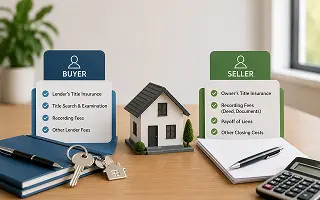
Title-related costs are usually one of the most common sources of confusion at closing, so let's take a quick look at how they are typically split between buyer and seller:
- Title Search Fee: This is usually paid by the buyer as part of the loan process and due diligence.
- Lender's Title Insurance: This is almost always paid by the buyer as a condition of getting a loan approved, since it protects the lender's financial interests.
- Owner's Title Insurance: This is the most variable of the title costs. In some states, the seller pays for it as a standard closing cost, while in others, the buyer pays. In many markets, however, it is negotiated as part of the purchase offer, and the cost is usually split between both parties.
- Settlement/Closing Fee: This is the service fee paid to the title company for their role as a neutral third party handling the title search, insurance, escrow, and closing process on behalf of everyone involved. This fee is typically split equally between buyer and seller.
How to Estimate Your Total Costs Before Closing

The best way to avoid surprises at the closing table is to gather as much data as possible early in the process. Here are a few ways to reliably estimate your closing costs:
- Request a Loan Estimate: This is a standardized document that breaks down all expected closing costs. By law, lenders must provide it within three business days of receiving your mortgage application. As a buyer, this is your single most accurate tool for estimating your closing costs.
- Ask For a Net Sheet: If you are selling, don't wait for the final offer to see your profit. Ask your real estate agent for a net sheet. This document estimates the sale proceeds after commissions, taxes, title costs, and other deductions, giving you a realistic picture of what you will actually walk away with.
- Use Online Calculators: These are useful for early planning before you apply for a loan or list a property and can give you a rough estimate of expected costs. However, keep in mind that this is just a ballpark figure, and they may not include county/city-specific transfer taxes or HOA transfer fees.
- Review Local Real Estate Data: Reviewing property records and recent comparable sales can give you an insight into what transfer taxes, recording fees, and other location-specific costs look like in your area.
Tips to Reduce Costs for Buyers and Sellers
Whether you are buying or selling, you can lower your closing costs and keep more money in your pockets by taking the following actions:
For Buyers:
- Negotiate Seller Concessions: Ask the seller to contribute toward your closing costs as part of the offer. Even a 2% contribution on a $250,000 home saves you $5,000 upfront. You typically have more leverage in a slow (buyer-friendly) market.
- Compare Lenders: Origination fees and lender costs vary between banks, credit unions, and online lenders. Getting and comparing two or three Loan Estimates can help you find better pricing and save a few hundred dollars.
- Shop for Title Services: You have the right to choose your own title company or settlement provider, even when the seller or lender recommends someone else. Take advantage of this by calling around, asking for quotes, and comparing pricing.
- Schedule Your Closing Strategically: Closing at the end of the month (where possible) can significantly reduce your “prepaid interest” costs. Because interest is calculated from the day you close until the first of the following month, closing on the 29th or 30th instead of the 5th can save you hundreds of dollars in upfront cash.
For Sellers:
- Explore Commission Options: Agent commissions are not fixed by law and can be negotiated. Talk to multiple agents and ask what services are included at different commission levels (e.g., full-service vs. entry-only). You may also consider alternative listing strategies.
- Be Strategic About Concessions: Offering a small, specific seller concession (like paying for the owner's title policy) can make your listing more attractive without costing as much as a price reduction.
- Audit Your Payoff Statement: Double-check your mortgage payoff statement for “release fees” or “prepayment penalties” before closing. If you spot an error or an outdated late fee, resolving it with your bank before the title company cuts the check can keep more profit in your pocket.
For Both Parties:
- Avoid Last-Minute Changes: Changes to the loan, property, or contract terms close to closing can trigger new fees or delays that add unexpected costs. Keep things as clean and simple as possible once you are under contract.
- Bundle Your Insurance: Always buy the lender's and owner's policies at the same time through the same company. Most title insurers offer a “simultaneous issue discount” when both policies are purchased together, which significantly lowers the combined premium compared to buying each policy separately. Also ask for a “re-issue rate” if the home has been owned for less than ten years; this is a discounted premium because the title company is “re-issuing” insurance on a property that was recently vetted.
Frequently Asked Questions
Who Pays Closing Costs, Buyer or Seller?
Both buyers and sellers pay closing costs, but they each cover different ones. Buyers usually pay lender fees, title-related costs, and upfront fees, while sellers cover agent commissions, agreed repairs, and transfer-related fees.
Can the Seller Pay All Closing Costs?
In theory, yes, depending on negotiation. However, while a seller may agree to cover most or all closing costs to make a deal more attractive, lenders often limit how much the seller can contribute through concessions (typically 2% to 6% of the purchase price).
Are Closing Costs Negotiable?
Yes, many closing costs are negotiable. The only costs that are truly fixed are government-imposed fees like transfer taxes and recording fees, and even then, who pays them can be negotiated.
What Fees Are Split Between Buyer and Seller?
Some costs, like transfer taxes or owner's title insurance, may be split depending on local customs and negotiation.
Who Pays Title Insurance?
Buyers typically pay for the lender's policy, while sellers often pay for the owner's policy or split the cost with the buyer. Note that this is not a universal rule. Always clarify who pays for what in your purchase agreement.
How Much Should Buyers and Sellers Budget for Closing Costs?
As a buyer, budget around 2% to 5% of the home's purchase price for closing costs (separate from any down payments). If you are selling, you can expect to pay around 6% to 10% of the sale price as closing costs.
Table of Contents
- Buyer or Seller: Who Pays for What in a Real Estate Transaction?
- Who Pays Closing Costs: Buyer or Seller?
- What Costs Does the Buyer Typically Pay?
- What Costs Does the Seller Typically Pay?
- Which Costs Are Negotiable Between Buyer and Seller?
- How Costs Vary by State and Local Practices
- How Title Costs Are Split Between Buyer and Seller
- How to Estimate Your Total Costs Before Closing
- Tips to Reduce Costs for Buyers and Sellers
- Frequently Asked Questions