Closing Costs by State: How Much Do Buyers Pay Across the U.S.?
If you are planning on buying a home, you've probably already heard about closing costs. You know, that final bundle of fees and charges required to round up the transaction. However, many homebuyers wrongly assume that these costs are consistent across the country.
In reality, closing costs are highly dependent on your location and can range anywhere from a few thousand to tens of thousands of dollars, based on state and municipal taxes, local regulations and customs, and the nature of the transaction. If you don't account for these regional variables early in the process, you could face a very expensive surprise at the closing table.
Table of Contents
- Closing Costs by State: How Much Do Buyers Pay Across the U.S.?
- What Are Closing Costs?
- Average Closing Costs by State
- Which States Have the Highest Closing Costs?
- Which States Have the Lowest Closing Costs?
- Why Closing Costs Vary by State
- Who Pays Closing Costs in Different States?
- How to Estimate Your Closing Costs Based on Location
- How to Reduce Closing Costs No Matter the State
- Frequently Asked Questions About Closing Costs by State
What Are Closing Costs?

Closing costs are the collection of fees and charges that you pay to finalize a real estate transaction. They typically include lender and loan-related fees, title and legal charges, government fees, and prepaid expenses (like property taxes and homeowner's insurance). Closing costs generally range between 2% and 5% of the home's purchase price, though exact amounts are heavily influenced by location.
Average Closing Costs by State
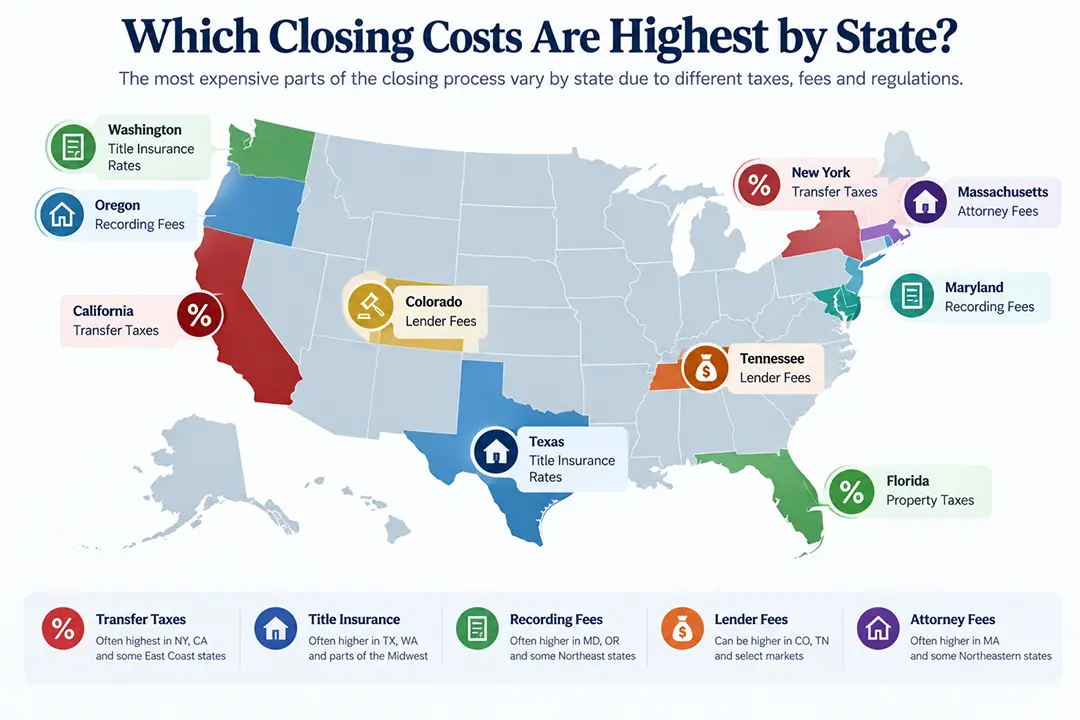
While the housing market is currently in a “slow and steady” phase, property values and interest rates remain high, directly impacting affecting closing costs. Recent data indicates that, on average, homebuyers pay approximately 1% of the property's purchase price as closing costs, though regional variables cause this to swing from as low as 0.4% to above 3%. In high-cost areas, taxes and other government-related fees typically make up the bulk of these expenses.
The table below provides a state-by-state breakdown of average closing costs across the United States:
| State | Average Costs (Without Taxes/Recording) | Average Total Closing Costs (Taxes/Recording Included) | Estimated Percentage of Home Price |
|---|---|---|---|

Alabama
|
$2,212 | $2,791 | 0.89% |

Alaska
|
$3,465 | $3,683 | 0.54% |

Arizona
|
$3,513 | $3,574 | 0.76% |

Arkansas
|
$1,782 | $2,440 | 0.84% |

California
|
$5,251 | $5,962 | 0.74% |

Colorado
|
$2,896 | $3,479 | 0.59% |

Connecticut
|
$3,570 | $4,249 | 0.93% |

Delaware
|
$3,376 | $12,157 | 2.99% |

District of Columbia
|
$5,689 | $17,545 | 2.39% |

Florida
|
$4,083 | $8,492 | 1.82% |

Georgia
|
$3,615 | $5,106 | 1.24% |

Hawaii
|
$5,336 | $5,921 | 0.62% |

Idaho
|
$3,435 | $3,497 | 0.70% |

Illinois
|
$3,751 | $4,702 | 1.30% |

Indiana
|
$1,697 | $1,810 | 0.70% |

Iowa
|
$1,390 | $1,640 | 0.64% |

Kansas
|
$1,832 | $2,369 | 0.80% |

Kentucky
|
$2,275 | $2,475 | 0.91% |

Louisiana
|
$3,069 | $3,513 | 1.20% |

Maine
|
$2,439 | $3,437 | 0.88% |

Maryland
|
$3,943 | $9,218 | 2.03% |

Massachusetts
|
$3,845 | $5,112 | 0.81% |

Michigan
|
$3,603 | $4,138 | 1.08% |

Minnesota
|
$2,413 | $3,492 | 0.91% |

Mississippi
|
$2,253 | $2,332 | 0.98% |

Missouri
|
$1,595 | $1,740 | 0.60% |

Montana
|
$2,844 | $3,157 | 0.60% |

Nebraska
|
$2,036 | $2,344 | 0.74% |

Nevada
|
$3,454 | $4,157 | 0.84% |

New Hampshire
|
$2,699 | $7,034 | 1.34% |

New Jersey
|
$3,623 | $5,410 | 0.92% |

New Mexico
|
$2,958 | $3,011 | 0.84% |

New York
|
$4,351 | $13,738 | 2.47% |

North Carolina
|
$2,302 | $2,480 | 0.56% |

North Dakota
|
$2,138 | $2,243 | 0.69% |

Ohio
|
$2,960 | $3,394 | 1.07% |

Oklahoma
|
$2,521 | $2,896 | 1.08% |

Oregon
|
$2,810 | $3,207 | 0.67% |

Pennsylvania
|
$3,248 | $8,259 | 2.36% |

Rhode Island
|
$3,031 | $3,810 | 0.75% |

South Carolina
|
$2,632 | $2,883 | 0.65% |

South Dakota
|
$1,199 | $1,551 | 0.46% |

Tennessee
|
$2,915 | $5,063 | 1.18% |

Texas
|
$3,529 | $3,713 | 0.93% |

Utah
|
$3,915 | $3,997 | 0.72% |

Vermont
|
$2,467 | $8,597 | 2.20% |

Virginia
|
$3,539 | $6,817 | 1.36% |

Washington
|
$3,747 | $5,995 | 1.01% |

West Virginia
|
$2,409 | $3,272 | 1.14% |

Wisconsin
|
$2,546 | $2,741 | 0.76% |

Wyoming
|
$2,942 | $3,070 | 0.76% |
Source: LodeStar Software Solutions: 2025 Purchase Mortgage Closing Cost Data Report.
Which States Have the Highest Closing Costs?
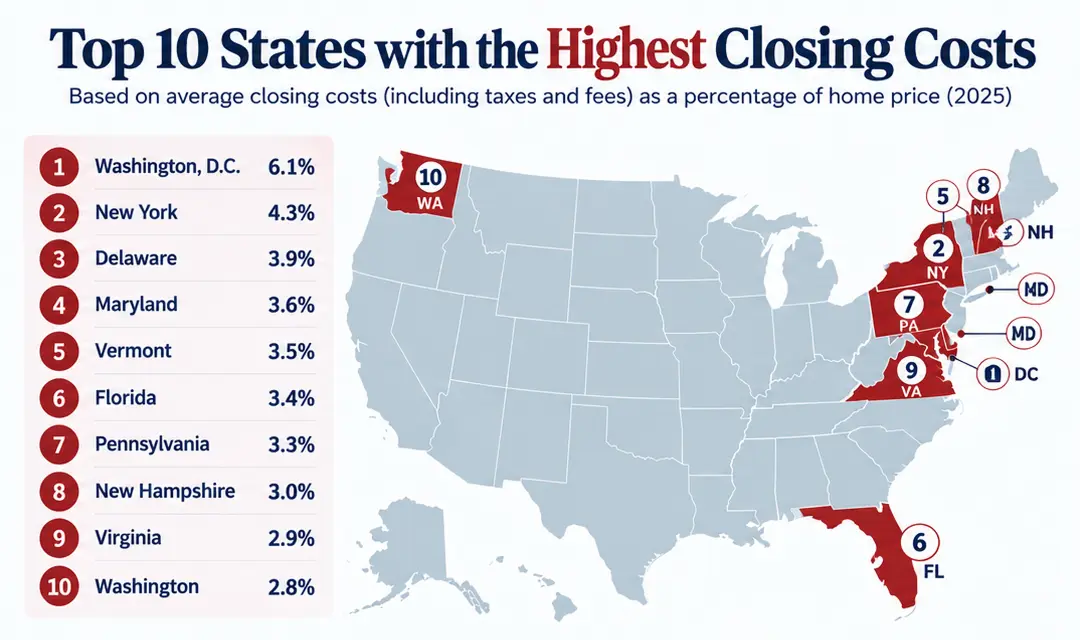
States with the highest closing costs generally have one thing in common: significant real estate transfer taxes. These are fees imposed by state or local governments when a property changes hands. These taxes usually account for the bulk of the closing costs buyers in these areas pay. Additional state-specific requirements, like mandatory attorney involvement in the closing process, also add to total costs:
- Washington, D.C.: Closing costs are higher in the nation's capital due to a combination of elevated home prices and steep transfer tax rates (currently about 1.1% for properties under $400,000 and 1.45% for those above that threshold). Dense urban regulations and specific legal requirements also add to overall closing costs.
- Delaware: Buyers in Delaware often pay some of the highest closing costs in the country as a percentage of sale price, largely due to hefty transfer taxes.
- New York: New Yorkers face a complex stack of costs, including mortgage recording taxes, title fees, and a “mansion tax” (an additional 1% or more on properties priced over $1 million). In New York City, additional municipal taxes make closing even more expensive.
- Maryland: Maryland imposes both state and county transfer taxes, as well as a “recordation tax”. These fees can easily add several thousand dollars to the final settlement.
- Vermont: Closing costs here are driven by the state's property transfer tax. Additionally, Vermont is an attorney-heavy state, meaning legal fees for title searches and deed preparation are typically higher than in states where title companies handle the entire process.
- Florida: In addition to paying documentary stamp taxes, buyers who finance their homes have to pay “intangible taxes” on the mortgage itself. Title insurance premiums and search fees in Florida also tend to be higher than the national average, further driving up closing costs.
- Pennsylvania: While local transfer and recording taxes vary widely across Pennsylvania's counties, the statewide average remains among the highest in the country. In some cities, like Philadelphia, the combined state and local transfer tax can reach over 4%.
Which States Have the Lowest Closing Costs?
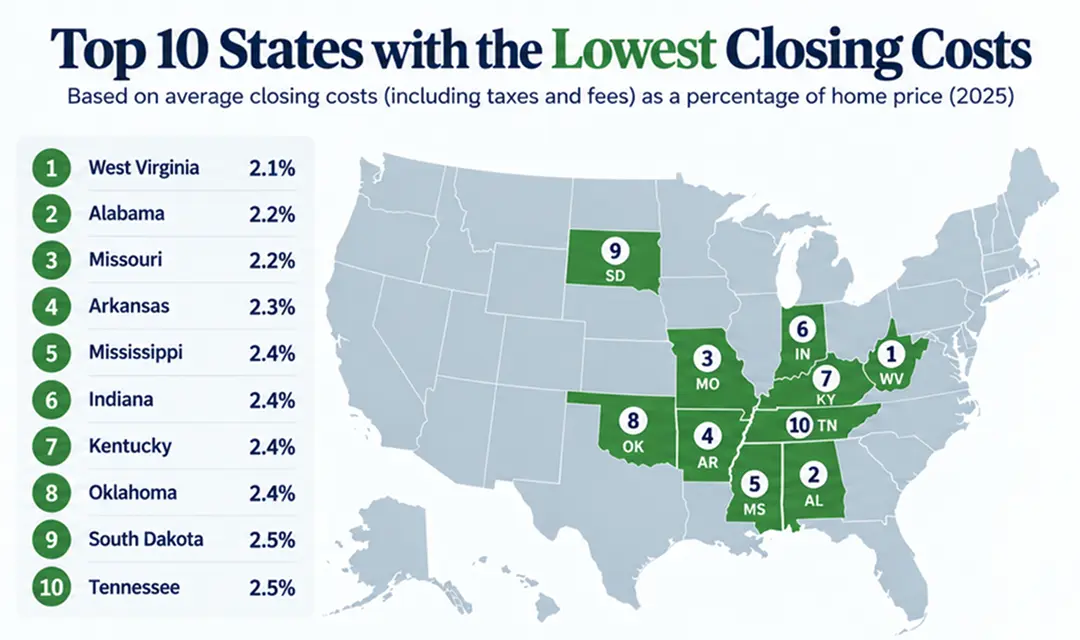
States with lower closing costs typically benefit from low real estate transfer taxes (or none at all), relatively lower home prices, and a competitive market for professional services. In these regions, the final bill mostly consists of lender fees, service fees, and prepaid expenses, not government charges. However, it is important to note that low closing costs do not always mean a cheaper home overall. Some states with low closing costs may also have high annual property taxes to make up for the lack of transfer taxes:
- South Dakota: Closing costs in the Mount Rushmore State are some of the lowest in the nation, thanks to no statewide transfer taxes and relatively low home prices.
- Iowa: Iowa's low transfer taxes and reasonable property values keep closing costs minimal.
- Missouri: Another state with minimal taxes and a straightforward closing process, which helps keep closing costs low.
- Indiana: Indiana's simple fee structures and low transfer taxes keep closing costs among the lowest in the country.
- North Dakota: Similar to its southern neighbor, North Dakota benefits from modest government fees and a lower-than-average cost of living, which translates to more affordable professional service rates for appraisals and inspections and keeps closing costs low.
- Mississippi: Mississippi is another state that does not impose a statewide transfer tax, which goes a long way in keeping total closing costs low.
- Nebraska: Nebraska's low closing costs are mostly due to a combination of moderate home prices and a relatively low tax structure compared to some of its Midwestern neighbors.
Why Closing Costs Vary by State
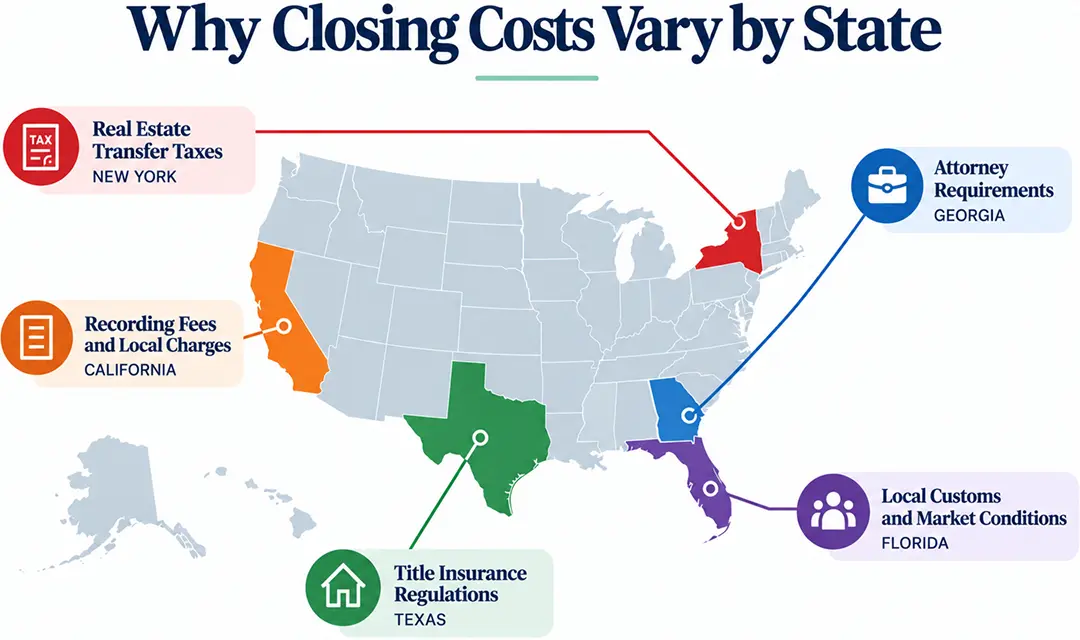
The state-by-state differences in closing costs across the country are primarily due to the following key factors:
- Real Estate Transfer Taxes: This is one of the biggest drivers of statewide closing cost variations. Some states charge little to no transfer tax at all, while others charge significant taxes that can add thousands to a transaction. These taxes are typically a percentage of the sale price, so they rise with home values.
- Recording Fees and Local Charges: State and local governments set their own fees for recording deeds and other documents. Even within a single state, county recording fees and deed stamp rates can vary. This means closing costs can differ between two homes in the same state but different counties.
- Title Insurance Regulations: Title insurance pricing is regulated differently by state. Some states fix rates, meaning that premiums are identical no matter which company you use, while in other states, companies are allowed to compete on pricing, which can lower costs by allowing you to shop around for savings.
- Attorney Requirements: In states like New York, Georgia, and South Carolina, a real estate attorney must be involved in the closing process. That adds a legal fee that buyers in other states may not pay.
- Local Customs and Market Conditions: In some regions, sellers traditionally pay for the owner's title insurance policy as a gesture that they are providing a “clear title”. In others, the buyer is expected to shoulder all expenses. These customs affect what shows up on the buyer's side of the closing statement.
Who Pays Closing Costs in Different States?

Closing costs are typically shared between buyers and sellers, but the exact breakdown is rarely a 50/50 split and often depends on local norms and negotiation.
In most states, the buyer pays the majority of these costs. This includes lender fees, the lender's title insurance policy, appraisal fees, and prepaid expenses. However, local custom can shift some costs to the seller. For example, while it is common for buyers to pay for their own title insurance and escrow fees in the northern part of California, these costs are often split or covered by the seller in Southern California.
Sellers also typically pay their own set of costs, with real estate agent commissions usually being the largest and most common. In some states, sellers also pay the owner's title insurance policy or transfer taxes as a courtesy to the buyer. For example, in Texas, it is a strong local custom for the seller to pay for the buyer's owner's title policy. This is seen as a way for them to “guarantee” that the title they are handing over is clean.
Seller concessions are also common in slower markets or if the buyer specifically requests one when making their purchase offer (a seller concession is when the seller agrees to pay a portion of the buyer's closing costs as part of the negotiation).
At the end of the day, nothing is set in stone. Even if local customs say the buyer pays for something, you can ask the seller to cover it as part of your offer. Regardless of what the norm may be in your area, the only thing that matters is what is written in your signed purchase agreement. Anything that is negotiated at the offer stage and clearly defined in the contract will be honored at the closing table.
How to Estimate Your Closing Costs Based on Location
The best way to avoid surprises at closing is to estimate your costs early in the process. Here are a few tips to help you with this:
- Request a Loan Estimate: This is a standardized document that breaks down all expected closing costs. By law, lenders must provide it within three business days of receiving your mortgage application. Loan estimates are your most powerful tool for budgeting your closing costs.
- Use Online Calculators: These tools are helpful for initial budgeting and can give you a rough estimate based on your location and purchase price, but you should always confirm with an actual Loan Estimate.
- Ask Your Real Estate Agent: Experienced agents know what buyers in your area commonly pay as closing costs. They can give you a ballpark figure based on recent transactions.
- Review Local Property Records and Transaction Data: Property records can give insight into transfer taxes and fees in your area. Most of this information can be accessed online through official county websites or through your title company and real estate attorney.
How to Reduce Closing Costs No Matter the State
Regardless of your location, you can reduce your closing costs by taking the following actions:
- Negotiate Seller Concessions: Ask the seller to contribute toward your closing costs as part of your purchase offer. Even a small 2% concession on a $350,000 home saves you $7,000.
- Compare Lenders: Different lenders charge different fees. If you will be taking out a loan for the purchase, request and review loan estimates from at least two or three different lenders. Doing this can reveal savings opportunities.
- Shop for Title/Settlement Services: Buyers can choose their own providers for some services (specifics may vary by state), and prices can often differ between companies. While your lender may recommend a title company, you are generally not required to use them.
- Leverage Buyer Assistance Programs: Many state and local governments run programs that offer grants or tax credits that can offset closing costs for qualifying buyers. Check with your local housing finance agency for eligibility and take advantage where applicable.
- Bundle Title Insurance Policies: Buying both the owner's and lender's title insurance policies together from the same company typically results in a lower combined premium, potentially saving you hundreds of dollars.
Frequently Asked Questions About Closing Costs by State
Which State Has the Highest Closing Costs?
New York, Delaware, and Maryland typically rank as the most expensive due to a combination of high real estate transfer taxes and property values. While technically not a state, Washington, D.C., also consistently tops lists of areas with the highest closing costs in the country.
Which State Has the Lowest Closing Costs?
States like South Dakota, Missouri, and Iowa tend to have some of the lowest closing costs due to minimal transfer taxes and lower home prices.
Do Closing Costs Vary Within a State?
Yes. Closing costs can vary significantly by county or city (within the same state) due to differences in local transfer taxes, recording fees, and service providers. Always estimate based on the specific property location, not just the state average.
Can Closing Costs Be Negotiated in Every State?
Yes, but what you can negotiate depends on your location. In states with regulated title insurance rates, that specific fee is fixed, along with government charges (recording fees and transfer taxes). However, lender fees, settlement fees, and seller concessions are almost always negotiable everywhere.
How Much Should I Expect to Pay in Closing Costs?
You should generally budget between 2% and 5% of the home's purchase price as closing costs. Note that actual costs vary by location and the specifics of the real estate transaction.
Are Closing Costs Tax Deductible?
Some closing costs, such as mortgage interest or property taxes, may be tax-deductible. However, many fees, like title insurance, appraisal fees, and lender charges, are not. It is best to consult a tax professional for specifics.
Table of Contents
- Closing Costs by State: How Much Do Buyers Pay Across the U.S.?
- What Are Closing Costs?
- Average Closing Costs by State
- Which States Have the Highest Closing Costs?
- Which States Have the Lowest Closing Costs?
- Why Closing Costs Vary by State
- Who Pays Closing Costs in Different States?
- How to Estimate Your Closing Costs Based on Location
- How to Reduce Closing Costs No Matter the State
- Frequently Asked Questions About Closing Costs by State